Background & Core Concepts
Modernizing legacy and evolving software across Python, Java, PHP, Go, TypeScript, and JavaScript is one of the highest-leverage challenges in engineering organizations. pni501 replaces fragile, ad-hoc LLM prompting with a deterministic harness that unites cascading polyglot rules, static and container telemetry, SQLite Pull-Push state management, and Drawlib visual reporting.
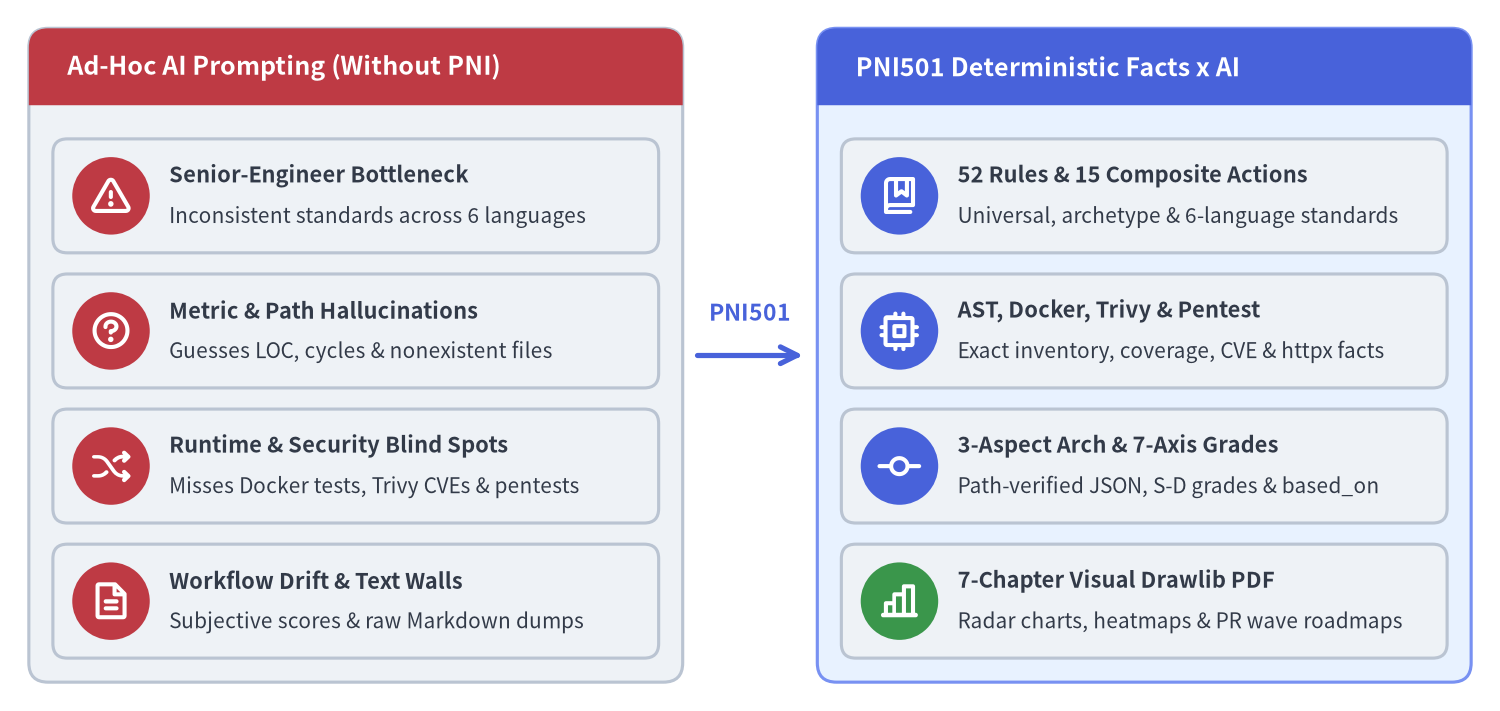
Source Code
from drawlib.canvas import save, setup
from drawlib.icons import phosphor
from drawlib.lines import line
from drawlib.smartarts import CardList, Panel
from drawlib.styles import Styles
from drawlib.text import text

setup(width=156, height=74, dpi=150)

left_panel = Panel(
    "Ad-Hoc AI Prompting (Without PNI)",
    header_variant="filled",
    style=Styles.Neutral.patch(shape_r=2.0),
    header_style=Styles.DangerFlat,
    text_style=Styles.WhiteBold.patch(text_size=12.0),
)
left_panel.draw(xy=(3.0, 3.0), width=68.0, height=68.0)

left_cards = CardList(
    style=Styles.Neutral.patch(shape_r=1.5),
    text_style=Styles.DarkBold.patch(text_size=10.5),
    description_style=Styles.Dark.patch(text_size=10.0),
    badge_shape="circle",
    badge_style=Styles.DangerFlat,
    badge_text_style=Styles.WhiteBold.patch(text_size=10.0),
    icon_style=Styles.WhiteBold,
    direction="vertical",
    spacing=2.2,
)
left_cards.add(
    "Senior-Engineer Bottleneck",
    "Inconsistent standards across 6 languages",
    icon=phosphor.warning,
)
left_cards.add(
    "Metric & Path Hallucinations",
    "Guesses LOC, cycles & nonexistent files",
    icon=phosphor.question,
)
left_cards.add(
    "Runtime & Security Blind Spots",
    "Misses Docker tests, Trivy CVEs & pentests",
    icon=phosphor.shuffle,
)
left_cards.add(
    "Workflow Drift & Text Walls",
    "Subjective scores & raw Markdown dumps",
    icon=phosphor.file_text,
)
left_cards.draw(xy=(5.5, 5.5), width=63.0, height=54.0)

line((72.5, 37.0), (83.5, 37.0), arrow_head="->", style=Styles.PrimaryBold.patch(line_width=2.5))
text((78.0, 41.5), "PNI501", style=Styles.PrimaryBold.patch(text_size=11.0))

right_panel = Panel(
    "PNI501 Deterministic Facts x AI",
    header_variant="filled",
    style=Styles.PrimaryNeutral.patch(shape_r=2.0),
    header_style=Styles.PrimaryFlat,
    text_style=Styles.WhiteBold.patch(text_size=12.0),
)
right_panel.draw(xy=(85.0, 3.0), width=68.0, height=68.0)

right_cards = CardList(
    style=Styles.Neutral.patch(shape_r=1.5),
    text_style=Styles.DarkBold.patch(text_size=10.5),
    description_style=Styles.Dark.patch(text_size=10.0),
    badge_shape="circle",
    badge_style=Styles.PrimaryFlat,
    badge_text_style=Styles.WhiteBold.patch(text_size=10.0),
    icon_style=Styles.WhiteBold,
    direction="vertical",
    spacing=2.2,
)
right_cards.add(
    "52 Rules & 15 Composite Actions",
    "Universal, archetype & 6-language standards",
    icon=phosphor.book_bookmark,
)
right_cards.add(
    "AST, Docker, Trivy & Pentest",
    "Exact inventory, coverage, CVE & httpx facts",
    icon=phosphor.cpu,
)
right_cards.add(
    "3-Aspect Arch & 7-Axis Grades",
    "Path-verified JSON, S-D grades & based_on",
    icon=phosphor.git_commit,
)
right_cards.add(
    "7-Chapter Visual Drawlib PDF",
    "Radar charts, heatmaps & PR wave roadmaps",
    badge_style=Styles.SuccessFlat,
    icon=phosphor.chart_bar,
)
right_cards.draw(xy=(87.5, 5.5), width=63.0, height=54.0)
save()
1. Why Ad-Hoc AI Prompting Fails on Real Repositories
Across enterprise backends, cloud microservices, frontend applications, and internal developer tooling, engineering teams manage heterogeneous repositories spanning Python, Java, PHP, Go, TypeScript, and JavaScript. Before any team can safely maintain, refactor, or migrate such codebases, engineers need an objective, reproducible baseline of structural quality, runtime reliability, and security posture.
While Code AI Agents (Claude Code, Gemini CLI, Cursor, GitHub Copilot, etc.) have transformed code comprehension, asking an LLM in a single chat prompt to "audit this repository and score its quality" suffers from four systemic failure modes:
- Senior-Engineer Prompt Bottleneck Across Ecosystems: Crafting prompts that simultaneously enforce universal architecture standards (OWASP ASVS, OpenSSF supply-chain hygiene, Twelve-Factor readiness, Google SRE PRR, CLI ergonomics) alongside language- and framework-specific idioms (
FastAPI,Spring Boot,Laravel,WordPress,Gomodules,TypeScriptstrictness) requires staff-level expertise on every run. - Quantitative & Structural Hallucinations: When inspecting repositories directly in chat, LLMs routinely guess LOC counts, fabricate type-annotation or generic coverage ratios, miss circular dependency SCCs (Strongly Connected Components), and cite file paths or line numbers that do not exist in the workspace.
- Runtime, Vulnerability & Penetration-Testing Blind Spots: Static text reading never verifies whether unit tests actually pass inside a clean container, what line/branch coverage is achieved, whether
Trivyflags critical CVEs, IaC misconfigurations, or hardcoded secrets, or whether live HTTP endpoints resist auth-bypass, SQLi/XSS, and SSRF probes under dynamic penetration testing. - Subjective Score Drift & Wall-of-Text Overload: In long chat sessions, agents vary their evaluation criteria from run to run, propose risky "big-bang" rewrites disconnected from the real import graph, and output thousands of lines of raw Markdown that cannot be tracked as longitudinal governance metrics.
2. The PNI501 Approach: Four Foundational Pillars
Project Nemesis Index (pni501 v0.1.4) solves these challenges by inverting control: instead of letting an LLM improvise the audit flow, the deterministic pni CLI and SQLite state machine drive the process, delegating only bounded, evidence-grounded reasoning and visual report authoring to the AI agent.
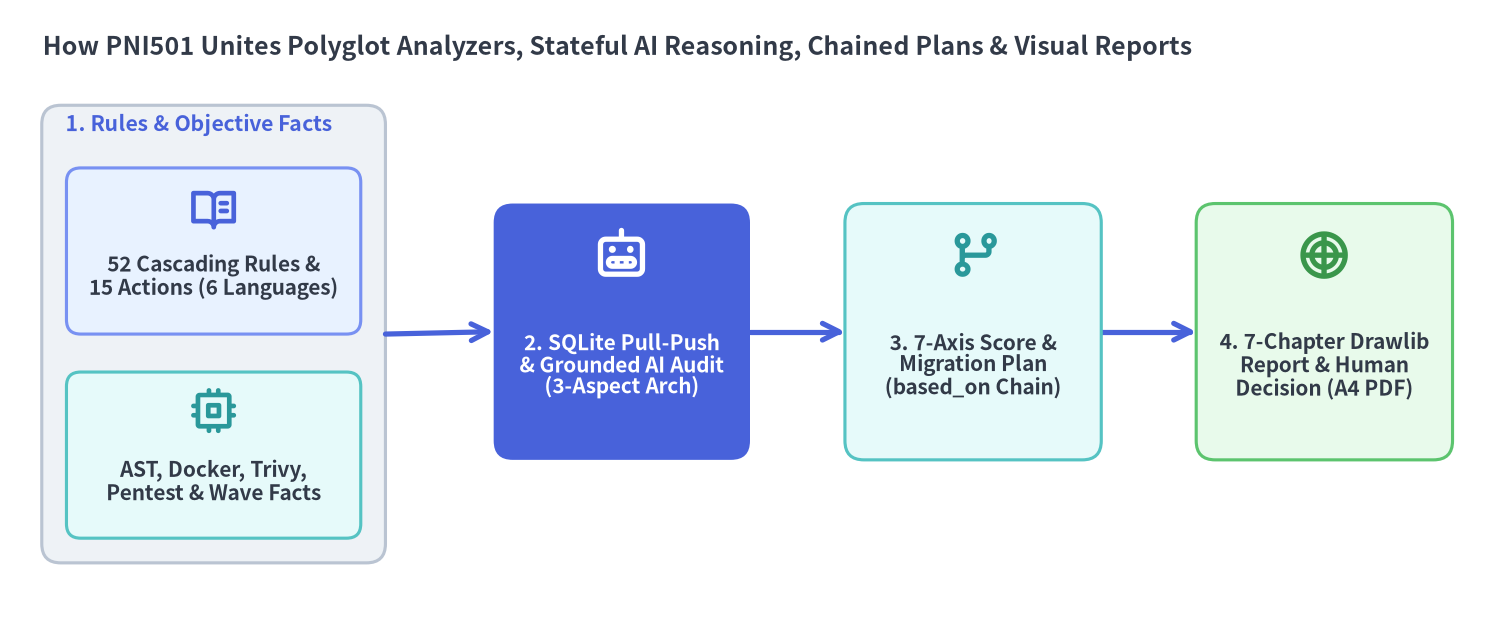
Source Code
from drawlib.canvas import save, setup
from drawlib.diagrams.architecture import (
    ArchitectureDiagram,
    Node,
    NodeGroup,
    PhosphorIcon,
)
from drawlib.styles import Colors, Styles
from drawlib.text import text

setup(width=158, height=66, dpi=150)

text(
    (4.5, 61.0),
    "How PNI501 Unites Polyglot Analyzers, Stateful AI Reasoning, Chained Plans & Visual Reports",
    style=Styles.DarkBold.patch(text_size=12.0, halign="left"),
)

white_card = Styles.Neutral.patch(shape_fill_color=Colors.White, shape_r=1.6)

diagram = ArchitectureDiagram(
    node_style=Styles.PrimaryBold,
    node_text_style=Styles.DarkBold.patch(text_size=10.0),
    node_card_style=white_card,
    edge_style=Styles.PrimaryBold,
    edge_text_style=Styles.Dark.patch(text_size=10.0),
)

prep_group = diagram.add(
    NodeGroup(
        title="1. Rules & Objective Facts",
        padding=2.6,
        style=Styles.Neutral.patch(shape_r=2.0),
        text_style=Styles.PrimaryBold.patch(text_size=10.2, halign="left"),
    ),
    xy=(4.5, 4.0),
)
n_rules = prep_group.add(
    Node(
        "52 Cascading Rules &\n15 Actions (6 Languages)",
        width=31.0,
        height=17.5,
        icon=PhosphorIcon.BOOK_OPEN_TEXT,
        icon_size=5.2,
        card_style=Styles.PrimaryNeutral.patch(shape_r=1.5),
    ),
    xy=(18.0, 35.5),
)
n_ast = prep_group.add(
    Node(
        "AST, Docker, Trivy,\nPentest & Wave Facts",
        width=31.0,
        height=17.5,
        icon=PhosphorIcon.CPU,
        icon_size=5.2,
        style=Styles.SecondaryBold,
        card_style=Styles.SecondaryNeutral.patch(shape_r=1.5),
    ),
    xy=(18.0, 14.0),
)

n_agent = diagram.add(
    Node(
        "2. SQLite Pull-Push\n& Grounded AI Audit\n(3-Aspect Arch)",
        width=27.0,
        height=27.0,
        icon=PhosphorIcon.ROBOT,
        icon_size=5.8,
        style=Styles.WhiteBold,
        text_style=Styles.WhiteBold.patch(text_size=10.0),
        card_style=Styles.PrimaryFlat.patch(shape_r=2.0),
    ),
    xy=(65.5, 31.0),
)

n_score_plan = diagram.add(
    Node(
        "3. 7-Axis Score &\nMigration Plan\n(based_on Chain)",
        width=27.0,
        height=27.0,
        icon=PhosphorIcon.GIT_BRANCH,
        icon_size=5.8,
        style=Styles.SecondaryBold,
        card_style=Styles.SecondaryNeutral.patch(shape_r=2.0),
    ),
    xy=(102.5, 31.0),
)

n_report = diagram.add(
    Node(
        "4. 7-Chapter Drawlib\nReport & Human\nDecision (A4 PDF)",
        width=27.0,
        height=27.0,
        icon=PhosphorIcon.CHART_POLAR,
        icon_size=5.8,
        style=Styles.SuccessBold,
        card_style=Styles.SuccessNeutral.patch(shape_r=2.0),
    ),
    xy=(139.5, 31.0),
)

diagram.connect(prep_group, n_agent, arrow="->", routing="direct")
diagram.connect(n_agent, n_score_plan, arrow="->", routing="direct")
diagram.connect(n_score_plan, n_report, arrow="->", routing="direct")

diagram.draw(xy=(0.0, 0.0))
save()
2.1 Pillar 1: Cascading Multi-Language Rules & Composite Actions (_rules & _actions)
Instead of relying on ad-hoc prompts, pni501 ships 52 built-in engineering rules across common/ and 6 language directories (python/, java/, php/, go/, typescript/, javascript/), paired with 15 composite actions per active language scope. Every built-in rule, action, and workflow supports non-destructive .pni/ local cascading overrides (local > <lang> > common) so organizations can codify team-specific conventions in Git. See Domain Architecture & Cascade for details.
2.2 Pillar 2: Zero-Hallucination Static, Container, Security & Pentest Analyzers
Anything countable, executable, or structurally provable is measured programmatically and cached in .pni/cache/<workflow_id>/facts.json:
- Polyglot Static & Manifest Inspection (
project_inspect,ast_analyze): Parses manifests (pyproject.toml,pom.xml,build.gradle,composer.json,go.mod,package.json,tsconfig.json), CI/governance files, Pythonast, andast-grep-pysyntax trees to extract exactmodule_inventory, LOC, type/generic/JSDoc ratios, cyclomatic complexity, API endpoints, security sinks, and cyclic import graphs. - Isolated Runtime, Security & Loopback Pentest Execution (
run_check,security_scan,web_pentest): Runs unit suites, coverage collection, and HTTP smoke probes in isolated containers; runs socketlessTrivyscans (vuln,misconfig,secret); and executes target-tailoredpytest+httpxWeb penetration tests against loopback containers. - Topological Wave & Progress Telemetry (
migration_analyze,progress_analyze): Computes strongly connected dependency cycles, external boundary touchpoints, bottom-uprefactoring_waves, and Git milestone/merge-tree conflict trajectories. See Analyzers & Live Pentest.
2.3 Pillar 3: Stateful Pull-Push Engine & Grounded Architecture (_workflows)
pni workflows drives the agent through a SQLite state machine (.pni/cache/workflow_state.db) via start, get-action, and push-action:
- 3-Aspect Grounded Architecture Recording (
record_architecture): Before scoring, the agent records system comprehension acrosspurpose_and_stack,layers_and_modules, andflows_and_state, while PNI validates every cited file path againstmodule_inventorybefore writing.pni/cache/<workflow_id>/architecture.json. - 7-Axis Health Scoring (
emit_score): Synthesizes rule evaluations and deterministic penalties (aggregator.py) into a validatedScoreResult(reports/<target>_score.json) acrossarchitecture,code_quality,typing,testing,dependencies,security, anddocumentation. - Prerequisite-Gated Chaining (
based_on): Migration workflows (category: migration) require aCOMPLETEDaudit run inworkflow_state.dband inherit its verified As-Is facts to emitreports/<target>_migration_plan.json. See Stateful Pull-Push Engine.
2.4 Pillar 4: Blueprint-Driven Visual Drawlib Reports (_reporter)
To eliminate wall-of-text review fatigue, _reporter generates a deterministic JSON blueprint (blueprint.json, migration_blueprint.json, or progress_blueprint.json) that guides the creation of a 7-chapter Drawlib report (00_cover.md + 01..06 under reports_src/<target>_src/). Combining executive KpiCards, 7-axis RadarCharts, 2D module HeatmapCharts, and phased P0–P2 / wave Roadmaps, pni report build compiles crisp A4 vector PDFs (reports/<target>.pdf). See Drawlib Visual Reporter.