7-Axis Scoring Model & Deterministic Aggregation
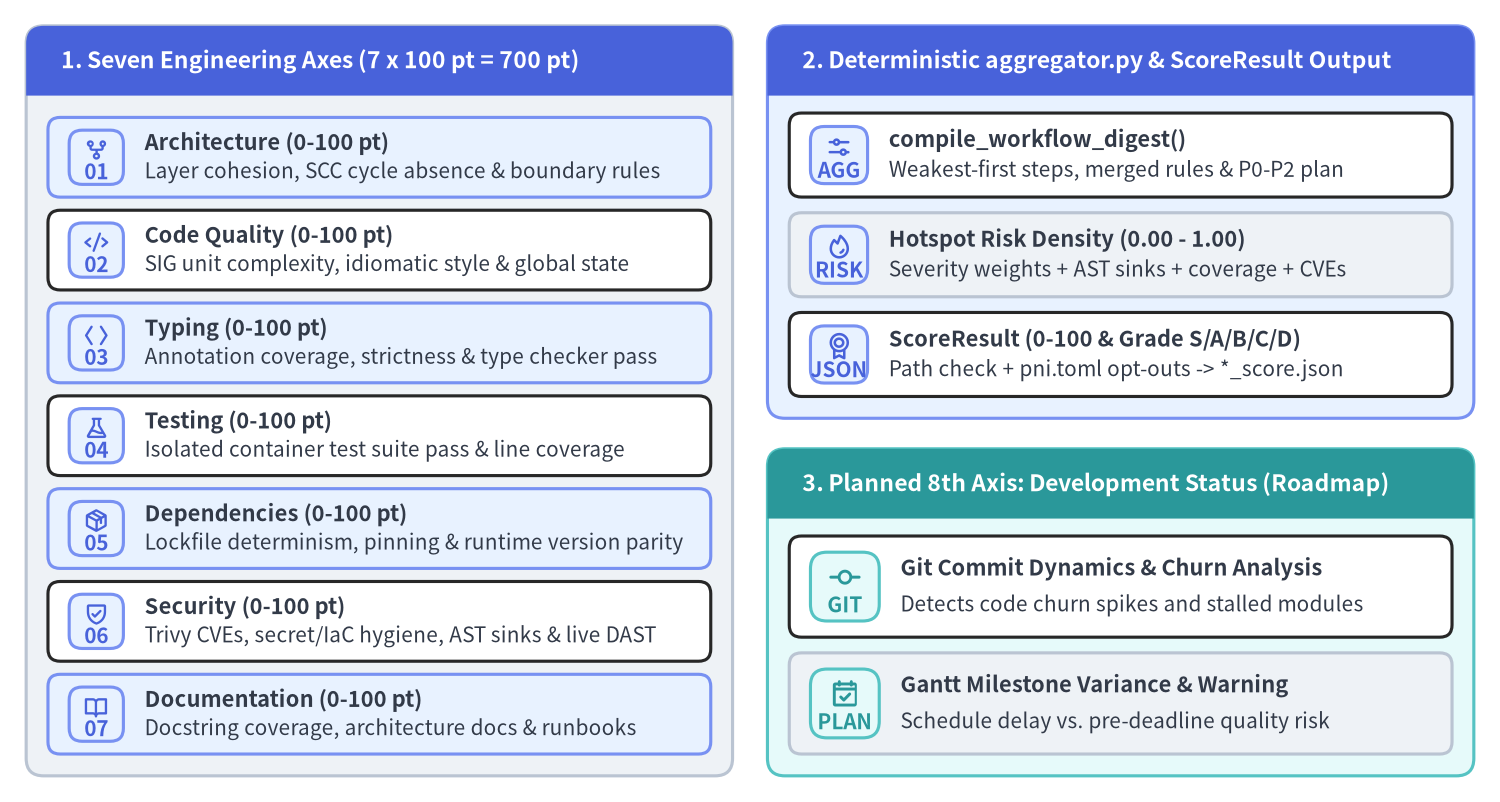
Once pni501 completes its deterministic static AST, container runtime, supply-chain security, and live HTTP penetration analyzers alongside schema-enforced AI evaluations, it synthesizes all diagnostic evidence into canonical JSON artifacts (ScoreResult and MigrationPlanResult). Rather than trusting raw LLM ordering or unverified file paths, aggregator.py and engine.py deterministically verify repository paths, apply pni.toml opt-out waivers, compute module hotspot risk densities, and pre-sort every finding, rule verdict, and remediation item.
Source Code
from drawlib.canvas import save, setup
from drawlib.icons import phosphor
from drawlib.smartarts import CardList, Panel
from drawlib.styles import Styles

setup(width=172, height=92, dpi=150)

axes_panel = Panel(
    "1. Seven Engineering Axes (7 x 100 pt = 700 pt)",
    header_variant="filled",
    header_height=8.0,
    style=Styles.Neutral.patch(shape_r=2.0),
    header_style=Styles.PrimaryFlat,
    text_style=Styles.WhiteBold.patch(text_size=11.0),
)
axes_panel.draw(xy=(3.0, 3.0), width=81.0, height=86.0)

axes_cards = CardList(
    style=Styles.WhiteBordered.patch(shape_r=1.4),
    text_style=Styles.DarkBold.patch(text_size=10.5),
    description_style=Styles.Dark.patch(text_size=10.0),
    badge_shape="rounded_rect",
    badge_style=Styles.PrimaryNeutral,
    badge_text_style=Styles.PrimaryBold.patch(text_size=10.0),
    icon_style=Styles.PrimaryBold,
    direction="vertical",
    spacing=1.5,
)
axes_cards.add(
    "Architecture (0-100 pt)",
    "Layer cohesion, SCC cycle absence & boundary rules",
    badge_text="01",
    icon=phosphor.git_fork,
    style=Styles.PrimaryNeutral.patch(shape_r=1.4),
)
axes_cards.add(
    "Code Quality (0-100 pt)",
    "SIG unit complexity, idiomatic style & global state",
    badge_text="02",
    icon=phosphor.code,
)
axes_cards.add(
    "Typing (0-100 pt)",
    "Annotation coverage, strictness & type checker pass",
    badge_text="03",
    icon=phosphor.brackets_angle,
    style=Styles.PrimaryNeutral.patch(shape_r=1.4),
)
axes_cards.add(
    "Testing (0-100 pt)",
    "Isolated container test suite pass & line coverage",
    badge_text="04",
    icon=phosphor.flask,
)
axes_cards.add(
    "Dependencies (0-100 pt)",
    "Lockfile determinism, pinning & runtime version parity",
    badge_text="05",
    icon=phosphor.package,
    style=Styles.PrimaryNeutral.patch(shape_r=1.4),
)
axes_cards.add(
    "Security (0-100 pt)",
    "Trivy CVEs, secret/IaC hygiene, AST sinks & live DAST",
    badge_text="06",
    icon=phosphor.shield_check,
)
axes_cards.add(
    "Documentation (0-100 pt)",
    "Docstring coverage, architecture docs & runbooks",
    badge_text="07",
    icon=phosphor.book_open,
    style=Styles.PrimaryNeutral.patch(shape_r=1.4),
)
axes_cards.draw(xy=(5.5, 5.5), width=76.0, height=73.0)

agg_panel = Panel(
    "2. Deterministic aggregator.py & ScoreResult Output",
    header_variant="filled",
    header_height=8.0,
    style=Styles.PrimaryNeutral.patch(shape_r=2.0),
    header_style=Styles.PrimaryFlat,
    text_style=Styles.WhiteBold.patch(text_size=11.0),
)
agg_panel.draw(xy=(88.0, 44.0), width=81.0, height=45.0)

agg_cards = CardList(
    style=Styles.WhiteBordered.patch(shape_r=1.4),
    text_style=Styles.DarkBold.patch(text_size=10.5),
    description_style=Styles.Dark.patch(text_size=10.0),
    badge_shape="rounded_rect",
    badge_style=Styles.PrimaryNeutral,
    badge_text_style=Styles.PrimaryBold.patch(text_size=10.0),
    icon_style=Styles.PrimaryBold,
    direction="vertical",
    spacing=1.8,
)
agg_cards.add(
    "compile_workflow_digest()",
    "Weakest-first steps, merged rules & P0-P2 plan",
    badge_text="AGG",
    icon=phosphor.sliders_horizontal,
)
agg_cards.add(
    "Hotspot Risk Density (0.00 - 1.00)",
    "Severity weights + AST sinks + coverage + CVEs",
    badge_text="RISK",
    icon=phosphor.fire,
    style=Styles.Neutral.patch(shape_r=1.4),
)
agg_cards.add(
    "ScoreResult (0-100 & Grade S/A/B/C/D)",
    "Path check + pni.toml opt-outs -> *_score.json",
    badge_text="JSON",
    icon=phosphor.medal,
)
agg_cards.draw(xy=(90.5, 46.5), width=76.0, height=32.5)

future_panel = Panel(
    "3. Planned 8th Axis: Development Status (Roadmap)",
    header_variant="filled",
    header_height=8.0,
    style=Styles.SecondaryNeutral.patch(shape_r=2.0),
    header_style=Styles.SecondaryFlat,
    text_style=Styles.WhiteBold.patch(text_size=11.0),
)
future_panel.draw(xy=(88.0, 3.0), width=81.0, height=37.5)

future_cards = CardList(
    style=Styles.WhiteBordered.patch(shape_r=1.4),
    text_style=Styles.DarkBold.patch(text_size=10.5),
    description_style=Styles.Dark.patch(text_size=10.0),
    badge_shape="rounded_rect",
    badge_style=Styles.SecondaryNeutral,
    badge_text_style=Styles.SecondaryBold.patch(text_size=10.0),
    icon_style=Styles.SecondaryBold,
    direction="vertical",
    spacing=1.8,
)
future_cards.add(
    "Git Commit Dynamics & Churn Analysis",
    "Detects code churn spikes and stalled modules",
    badge_text="GIT",
    icon=phosphor.git_commit,
)
future_cards.add(
    "Gantt Milestone Variance & Warning",
    "Schedule delay vs. pre-deadline quality risk",
    badge_text="PLAN",
    icon=phosphor.calendar_check,
    style=Styles.Neutral.patch(shape_r=1.4),
)
future_cards.draw(xy=(90.5, 5.5), width=76.0, height=25.0)

save()
1. The 7 Implemented Quality Axes (700-Point Pool & Grade Mapping)
Every health audit workflow evaluates a target repository across seven standardized engineering axes defined in CategoryScores (src/pni/_actions/base_model.py). Each axis is scored on a 0..100 integer scale (700 total raw points across the seven axes) and paired with evidence-backed rationales in CategoryRationales, synthesizing into a normalized 0..100 overall_score:
| # | Axis Key | Points | Primary Deterministic Signals & Evaluation Scope |
|---|---|---|---|
| 1 | architecture |
0..100 |
Package/layer cohesion, dependency directionality, absence of strongly connected component (SCC) import cycles, and framework/domain boundary separation. |
| 2 | code_quality |
0..100 |
SIG-aligned unit complexity, function length and parameter counts, idiomatic constructs, structured logging, I/O timeout hygiene, and absence of mutable global state. |
| 3 | typing |
0..100 |
Type-annotation coverage (type_safety_coverage_pct), strictness declarations (py.typed, generics, strict_types=1, tsconfig strict), and static type-checker cleanliness. |
| 4 | testing |
0..100 |
Automated test suite breadth, assertion density, isolated container harness pass rate (run_check), smoke checks, and measured line/branch coverage. |
| 5 | dependencies |
0..100 |
Manifest and lockfile determinism, version-pinning discipline, declared runtime compatibility (language_version_mismatches), and absence of undeclared imports. |
| 6 | security |
0..100 |
Application and OS container CVE posture (security_scan via Trivy), secret hygiene, IaC/Dockerfile hardening, CWE-classified AST sinks (dangerous_sinks), and live HTTP penetration test verdicts (web_pentest). |
| 7 | documentation |
0..100 |
Public module/callable docstring coverage (docstring_coverage_pct), onboarding/architecture guides, governance files (SECURITY.md, LICENSE), and operational runbooks. |
1.1 HealthGrade Mapping (S / A / B / C / D)
Both the repository's overall_score and each step's AuditDimensionScore map deterministically to a five-tier HealthGrade via score_to_grade() in src/pni/_workflows/aggregator.py:
| Grade | Score Threshold | Engineering Interpretation |
|---|---|---|
S |
90 .. 100 |
Exemplary reference architecture with near-zero structural, runtime, or security debt. |
A |
80 .. 89 |
Production-ready engineering hygiene with minor, non-blocking improvement opportunities. |
B |
70 .. 79 |
Sound structural foundation carrying localized test coverage, dependency, or hardening gaps. |
C |
60 .. 69 |
Elevated maintainability or operational risk requiring prioritized remediation before scaling. |
D |
< 60 |
Critical architectural, build/runtime, or exploitable security debt requiring structured intervention. |
1.2 Future Roadmap: 8th Axis (Development Status & Schedule Variance)
Beyond the seven implemented code and runtime axes, the pni501 roadmap defines an eighth evaluation axis—Development Status (development_status)—to combine static engineering health with delivery trajectory monitoring:
- Git Commit Velocity & Churn Dynamics: Analyzes commit history to identify sudden code-churn spikes, hotfix clusters, or stalled core modules.
- Gantt Milestone Variance Cross-Check: Compares planned milestone schedules against actual repository implementation progress across features and subsystems.
- Crunch-Time Quality Degradation Early Warning: Detects when schedule slippage coincides with rapid pre-deadline commit churn, alerting engineering leads before test coverage or architectural boundaries are bypassed.
2. Deterministic Enrichment & Pre-Sorting in aggregator.py
When an AI agent submits ScoreResult during the terminal emit_score action, src/pni/_workflows/engine.py:_enrich_score_result() never trusts raw LLM sorting or unverified file references. Instead, it re-assembles the WorkflowFactsBundle from .pni/cache/workflow_state.db, verifies every referenced file_path and target_files entry against the real repository and AstFacts.module_inventory, stamps immutable provenance (workflow_id, workflow_run_id, UTC evaluated_at, target_root, facts_file, recomputed grade, and metrics_snapshot), and replaces list fields with the canonical output of aggregator.py:compile_workflow_digest().
2.1 Weakest-First Dimensions, Rule Compliance & Consolidated Findings
audit_dimensions(Weakest-First Step Scorecards): Aggregates every completedai_interpretaction into anAuditDimensionScore(pass_count,warn_count,fail_count,score,grade) sorted ascending by(score, -fail_count, -warn_count, seq)so the weakest engineering dimensions appear first. Ifstep_scoreis omitted,_compute_step_score()deterministically falls back to the mean ofsuggested_scoresor100 - sum(SEVERITY_DEDUCTION)(critical=35,high=20,medium=10,low=3,info=1).rule_compliance(fail -> warn -> pass -> not_applicable):normalize_step_rule_checks()guarantees every active rule on every step receives a stampedRuleCheckResult(inferring verdicts from step findings when omitted).merge_and_sort_rule_compliance()deduplicates rules across steps—retaining the strictest status while concatenating unique evidence—and sorts by(STATUS_RANK[status], rule_id).findings& Location-Groupedconsolidated_findings:deduplicate_and_sort_findings()orders raw findings bycritical -> high -> medium -> low -> info. Next,consolidate_findings_by_location()(src/pni/_actions/base_model.py) buckets overlapping violations sharing the exact same(file_path, line)into a single multi-ruleConsolidatedFinding(rule_ids,combined_evidence,merged_recommendation), preventing duplicate table rows in downstream PDF reports.action_plan(P0 -> P1 -> P2):deduplicate_and_sort_actions()deduplicates remediation items by(priority, title.lower())and sorts deterministically by(PRIORITY_RANK[priority], category, title).- Declarative
pni.tomlOpt-Out Waivers (opt_outs):_filter_findings_by_opt_out()andnormalize_step_rule_checks()honor[[opt_out]]entries declared inpni.toml(matching by rule/checkidand optional filescopeglobs), waiving matching findings, marking repo-wide opted-out rules asnot_applicable, and recording transparentAppliedOptOutaudit trails inScoreResult.opt_outs.
2.2 Module Hotspot Risk Density Formula (0.00 to 1.00)
compute_module_hotspots() scores every discovered source module and flagged infrastructure file on a bounded [0.00, 1.00] scale sorted descending by (-risk_score, -loc, file_path). Clean modules with zero findings and zero structural/runtime/security bonuses receive a baseline healthy score of 0.06 (_BASE_HEALTHY_RISK), whereas flagged modules combine four deterministic signal sources:
SEVERITY_RISK_WEIGHT = {
    "critical": 0.45,
    "high": 0.28,
    "medium": 0.15,
    "low": 0.06,
    "info": 0.02,
}
_BASE_HEALTHY_RISK = 0.06

# Per-file hotspot risk density in [0.00, 1.00]:
# 1. raw_weight = sum(SEVERITY_RISK_WEIGHT[f.severity] for f in file_findings)
# 2. ast_bonus  = +0.12 (complex_functions) + 0.14 (global_state)
#                 + 0.25 (hardcoded_secrets) + min(0.30, 0.12 * sink_count)
# 3. cov_bonus  = +0.16 (0.0% line coverage) or +0.10 (0.1%..49.9% coverage, >=5 stmts)
# 4. sec_bonus  = min(0.30, 0.15 * trivy_secret_or_iac_hits)
risk_score = round(min(1.0, raw_weight + ast_bonus + cov_bonus + sec_bonus), 2)
3. Path-Grounded MigrationPlanResult Schema
For repositories requiring structured modernization (category: migration, based_on: <audit_workflow_id>), the emit_migration_plan action validates and persists MigrationPlanResult (src/pni/_actions/migration_analyze/models.py), verifiable via pni validate-migration-plan <path>:
- Execution Guardrails: Pins
transformation_mode(same_lang_upgrade,architectural_restructure, orcross_stack_replacement),migration_strategy(phased_pr,strangler_fig, orrewrite),api_compatibility(strict,versioned_v2, orflexible), andbug_handling_policy(ask_human,preserve_behavior, orfix_in_phase3), alongsideconfirmed_assumptionsand explicitnon_goals. target_axes(MigrationAxis) &target_architecture: Captures each As-Is to To-Be transformation vector (language_runtime,framework,architecture_pattern,database_persistence,cache_state,auth_security,messaging_async,container_cicd,custom) with groundedaffected_files, plustarget_layers(allowed_dependencies,forbidden_imports) and file-levelcomponent_mappings.decision_log(DecisionLogItem,DEC-01..NN): Isolates ambiguous legacy behaviors ("Spec vs. Bug" under Hyrum's Law) withcurrent_behavior,impact_if_changed, andrecommended_optionfor Product Owner sign-off prior to Phase 3 business-logic changes.phase_gates(Phases 0..4) &pr_wbs(PR-01..NN): Enforces a 5-stage gated roadmap—Phase 0 (Characterization & Harness Recovery), Phase 1 (Cycle Cutting & Port Extraction), Phase 2 (Mechanical Codemods & DB/Cache Adapters), Phase 3 (Typed DTOs & Approved Fixes), and Phase 4 (Cutover & CI/Container Hardening)—paired with topologically ordered PR tickets enriched with deterministicMigrationFacts(refactoring_waves,cycle_cuts,implicit_contracts,boundary_touchpoints, andmechanical_codemods).
4. 9-Target Multi-Language Benchmark Matrix
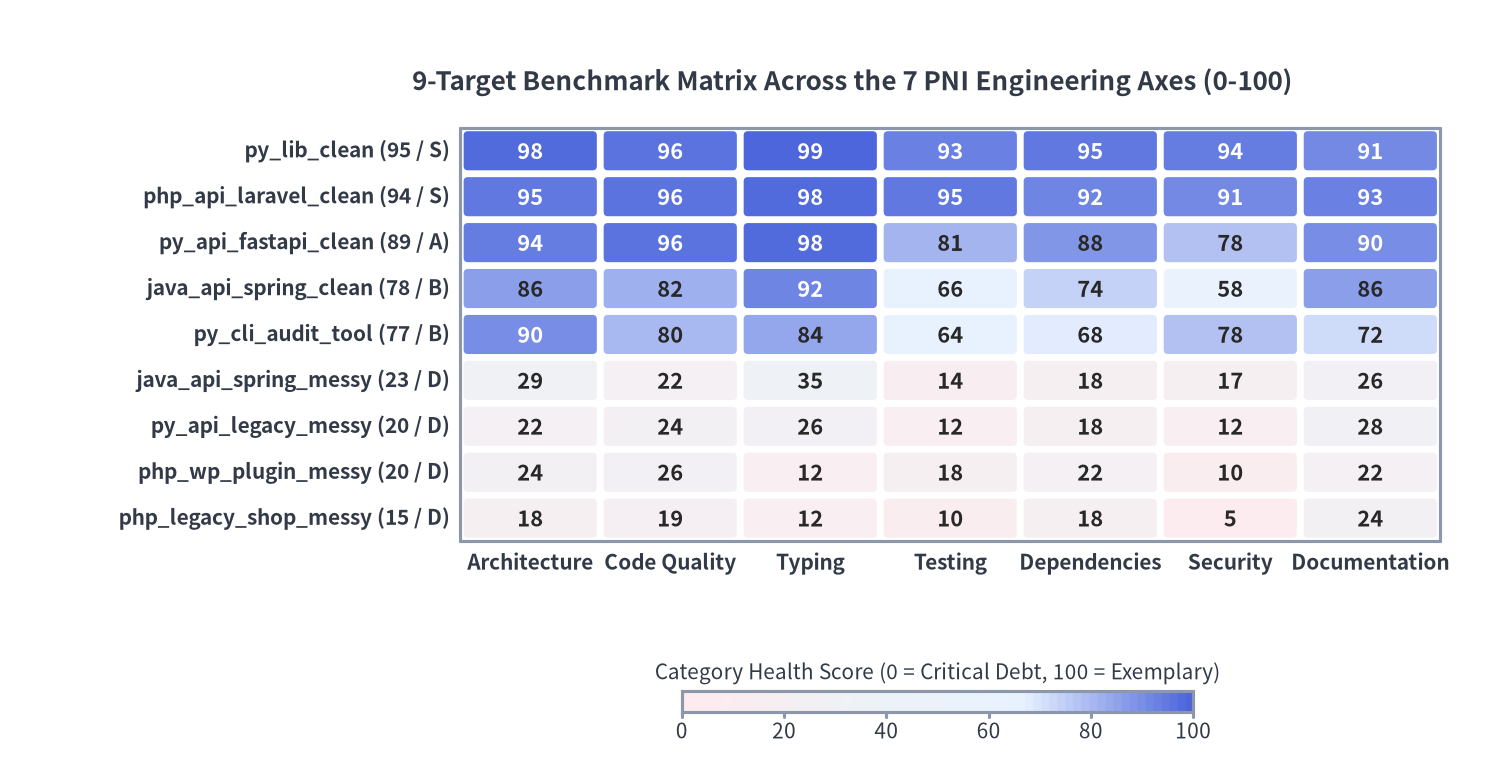
To validate scoring calibration across clean production architectures, mid-tier services, and severely degraded legacy codebases, pni501 maintains nine end-to-end benchmark repositories under examples/{python,java,php}/ along with their committed ScoreResult JSONs and compiled A4 PDF reports under reports/{python,java,php}/.
Source Code
from drawlib.canvas import save, setup
from drawlib.charts.heatmap import HeatmapChart
from drawlib.styles import Styles

setup(width=176, height=90, dpi=150)

chart = HeatmapChart(
    styles=[Styles.DangerNeutral, Styles.Neutral, Styles.PrimaryNeutral, Styles.PrimaryFlat],
    x_categories=[
        "Architecture",
        "Code Quality",
        "Typing",
        "Testing",
        "Dependencies",
        "Security",
        "Documentation",
    ],
    min_value=0.0,
    max_value=100.0,
    cell_gap=0.8,
    cell_r=0.5,
    value_format="{:.0f}",
    auto_contrast_text=True,
    axis_line_style=Styles.Muted,
    axis_text_style=Styles.DarkBold.patch(text_size=10.0),
    value_text_style=Styles.DarkBold.patch(text_size=10.5),
    width=144.0,
    height=62.0,
    title="9-Target Benchmark Matrix Across the 7 PNI Engineering Axes (0-100)",
    title_style=Styles.DarkBold.patch(text_size=12.5),
)

chart.add_row("py_lib_clean (95 / S)", [98, 96, 99, 93, 95, 94, 91])
chart.add_row("php_api_laravel_clean (94 / S)", [95, 96, 98, 95, 92, 91, 93])
chart.add_row("py_api_fastapi_clean (89 / A)", [94, 96, 98, 81, 88, 78, 90])
chart.add_row("java_api_spring_clean (78 / B)", [86, 82, 92, 66, 74, 58, 86])
chart.add_row("py_cli_audit_tool (77 / B)", [90, 80, 84, 64, 68, 78, 72])
chart.add_row("java_api_spring_messy (23 / D)", [29, 22, 35, 14, 18, 17, 26])
chart.add_row("py_api_legacy_messy (20 / D)", [22, 24, 26, 12, 18, 12, 28])
chart.add_row("php_wp_plugin_messy (20 / D)", [24, 26, 12, 18, 22, 10, 22])
chart.add_row("php_legacy_shop_messy (15 / D)", [18, 19, 12, 10, 18, 5, 24])

chart.draw(xy=(28.0, 21.0))
chart.draw_colorbar(
    xy=(80.0, 6.5),
    text_style=Styles.Dark.patch(text_size=10.0),
    length=60.0,
    thickness=2.4,
    num_ticks=6,
    value_format="{:.0f}",
    label="Category Health Score (0 = Critical Debt, 100 = Exemplary)",
)

save()
4.1 Ground-Truth Audit Scores Across Clean, Mid-Tier, and Legacy Targets
The nine benchmark targets span three Grade S/A reference implementations, two realistic mid-tier Grade B repositories (where pni501 surfaces container base-image CVEs, unauthenticated Actuator/API routes, or branch-coverage gaps despite clean code structure), and four severely degraded Grade D legacy applications:
| Workflow ID | Project Name | Stack Profile | Overall | Arch | Qual | Type | Test | Deps | Sec | Docs | Emitted Artifacts (reports/...) |
|---|---|---|---|---|---|---|---|---|---|---|---|
py_lib_clean |
metrics-kit |
Python 3.12 library | 95 (S) | 98 | 96 | 99 | 93 | 95 | 94 | 91 | python/lib_clean{_score.json,.pdf} |
php_api_laravel_clean |
order-fulfillment |
PHP 8.3 / Laravel 11 API | 94 (S) | 95 | 96 | 98 | 95 | 92 | 91 | 93 | php/api_laravel_clean{_score.json,.pdf} |
py_api_fastapi_clean |
order-dispatch |
Python 3.12 / FastAPI | 89 (A) | 94 | 96 | 98 | 81 | 88 | 78 | 90 | python/api_fastapi_clean{_score.json,.pdf} |
java_api_spring_clean |
inventory-service |
Java 21 / Spring Boot 3 | 78 (B) | 86 | 82 | 92 | 66 | 74 | 58 | 86 | java/api_spring_clean{_score.json,.pdf} |
py_cli_audit_tool |
logpulse |
Python CLI utility | 77 (B) | 90 | 80 | 84 | 64 | 68 | 78 | 72 | python/cli_audit_tool{_score.json,.pdf} |
java_api_spring_messy |
legacy-billing |
Legacy Java 8/11 Spring | 23 (D) | 29 | 22 | 35 | 14 | 18 | 17 | 26 | java/api_spring_messy{_score.json,.pdf} |
py_api_legacy_messy |
legacy-order-hub |
Legacy Python Flask API | 20 (D) | 22 | 24 | 26 | 12 | 18 | 12 | 28 | python/api_legacy_messy{_score.json,.pdf} |
php_wp_plugin_messy |
wp_plugin_messy |
Procedural WP plugin | 20 (D) | 24 | 26 | 12 | 18 | 22 | 10 | 22 | php/wp_plugin_messy{_score.json,.pdf} |
php_legacy_shop_messy |
legacy_shop_messy |
Procedural PHP 7.4 shop | 15 (D) | 18 | 19 | 12 | 10 | 18 | 5 | 24 | php/legacy_shop_messy{_score.json,.pdf} |
Next, see Drawlib Visual Reporter for how pni501 compiles ScoreResult and MigrationPlanResult into 7-chapter vector PDF reports, or Supported 6 Languages for language-specific analyzer details.