Domain Architecture & Three-Tier Cascade Resolution
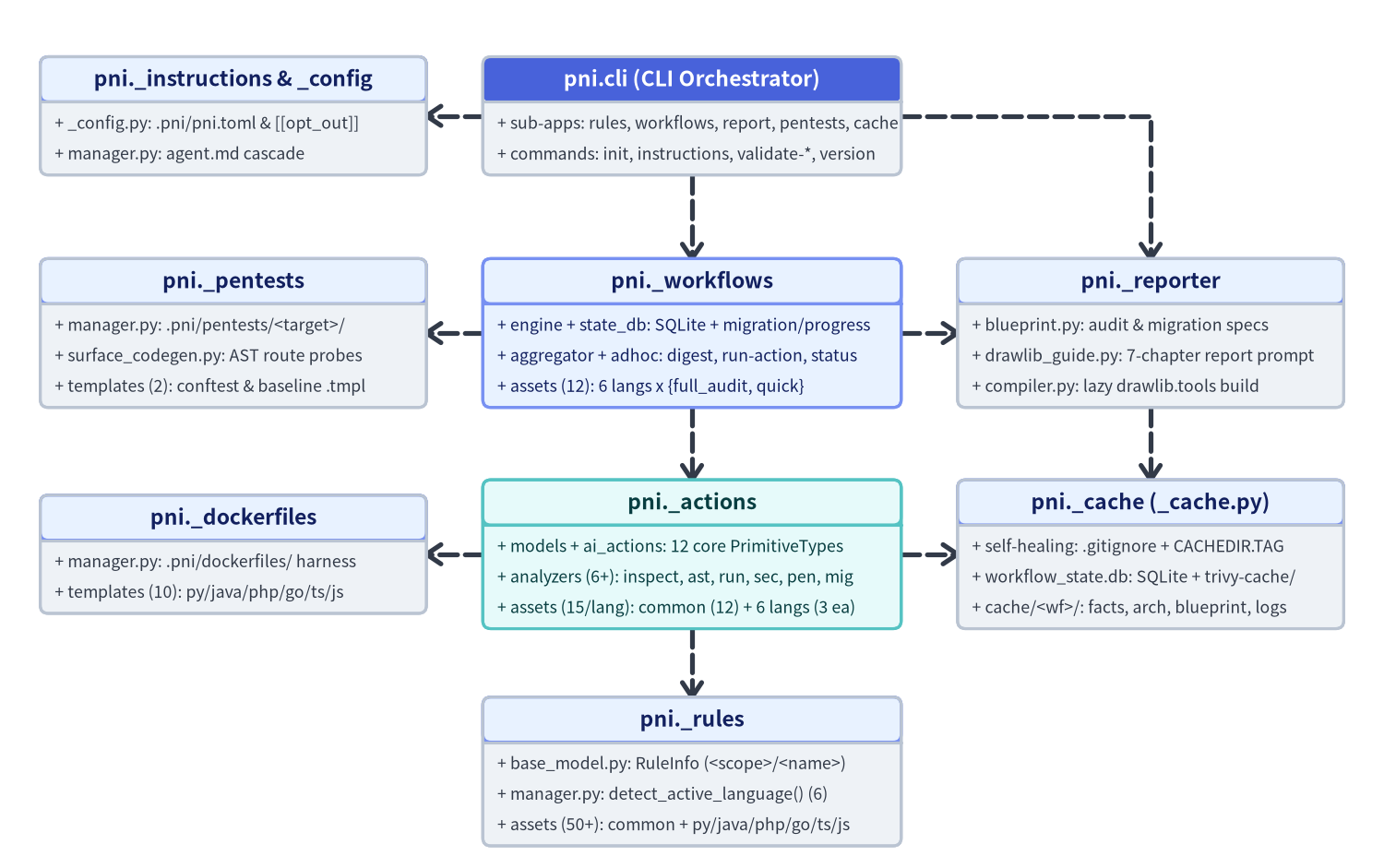
pni501 (v0.1.4) organizes its implementation under src/pni/ around seven vertical domain packages (_workflows, _actions, _reporter, _rules, _pentests, _dockerfiles, and _instructions), a project manifest loader (_config.py), a self-healing cache utility (_cache.py), and a thin Typer + Rich CLI orchestrator (cli.py). Each domain colocates its Pydantic v2 schemas, execution or resolution logic, and built-in .md, .yaml, .dockerfile, or .tmpl assets across all 6 supported languages (python, java, php, go, typescript, and javascript)—preserving a strict module-level Directed Acyclic Graph (circular_dependencies = []).
Source Code
from drawlib.canvas import save, setup
from drawlib.diagrams.class_diagram import ClassDiagram, ClassNode
from drawlib.styles import Colors, Styles

setup(width=172, height=108, dpi=150)

diagram = ClassDiagram(
    node_style=Styles.Neutral.patch(text_size=10.0),
    header_style=Styles.PrimaryNeutral.patch(text_size=10.5),
    edge_style=Styles.DarkBold,
    edge_text_style=Styles.PrimaryBold.patch(text_size=10.0),
)

inst_node = ClassNode(
    "pni._instructions & _config",
    width=48.0,
    header_height=5.6,
    row_height=3.8,
)
inst_node.add_attribute("_config.py", ".pni/pni.toml & [[opt_out]]")
inst_node.add_attribute("manager.py", "agent.md cascade")
diagram.add(inst_node, xy=(29.0, 93.5))

cli_node = ClassNode(
    "pni.cli (CLI Orchestrator)",
    width=52.0,
    header_height=5.6,
    row_height=3.8,
    header_style=Styles.PrimaryFlat.patch(text_color=Colors.White, text_size=10.5),
)
cli_node.add_attribute("sub-apps", "rules, workflows, report, pentests, cache")
cli_node.add_attribute("commands", "init, instructions, validate-*, version")
diagram.add(cli_node, xy=(86.0, 93.5))

pentest_node = ClassNode(
    "pni._pentests",
    width=48.0,
    header_height=5.6,
    row_height=3.8,
)
pentest_node.add_attribute("manager.py", ".pni/pentests/<target>/")
pentest_node.add_attribute("surface_codegen.py", "AST route probes")
pentest_node.add_attribute("templates (2)", "conftest & baseline .tmpl")
diagram.add(pentest_node, xy=(29.0, 66.5))

wf_node = ClassNode(
    "pni._workflows",
    width=52.0,
    header_height=5.6,
    row_height=3.8,
    style=Styles.PrimaryNeutral.patch(text_size=10.0),
)
wf_node.add_attribute("engine + state_db", "SQLite + migration/progress")
wf_node.add_attribute("aggregator + adhoc", "digest, run-action, status")
wf_node.add_attribute("assets (12)", "6 langs x {full_audit, quick}")
diagram.add(wf_node, xy=(86.0, 66.5))

rep_node = ClassNode(
    "pni._reporter",
    width=48.0,
    header_height=5.6,
    row_height=3.8,
)
rep_node.add_attribute("blueprint.py", "audit & migration specs")
rep_node.add_attribute("drawlib_guide.py", "7-chapter report prompt")
rep_node.add_attribute("compiler.py", "lazy drawlib.tools build")
diagram.add(rep_node, xy=(143.0, 66.5))

docker_node = ClassNode(
    "pni._dockerfiles",
    width=48.0,
    header_height=5.6,
    row_height=3.8,
)
docker_node.add_attribute("manager.py", ".pni/dockerfiles/ harness")
docker_node.add_attribute("templates (10)", "py/java/php/go/ts/js")
diagram.add(docker_node, xy=(29.0, 39.0))

act_node = ClassNode(
    "pni._actions",
    width=52.0,
    header_height=5.6,
    row_height=3.8,
    style=Styles.SecondaryNeutral.patch(text_size=10.0),
    header_style=Styles.SecondaryNeutral.patch(text_size=10.5),
)
act_node.add_attribute("models + ai_actions", "12 core PrimitiveTypes")
act_node.add_attribute("analyzers (6+)", "inspect, ast, run, sec, pen, mig")
act_node.add_attribute("assets (15/lang)", "common (12) + 6 langs (3 ea)")
diagram.add(act_node, xy=(86.0, 39.0))

cache_node = ClassNode(
    "pni._cache (_cache.py)",
    width=48.0,
    header_height=5.6,
    row_height=3.8,
)
cache_node.add_attribute("self-healing", ".gitignore + CACHEDIR.TAG")
cache_node.add_attribute("workflow_state.db", "SQLite + trivy-cache/")
cache_node.add_attribute("cache/<wf>/", "facts, arch, blueprint, logs")
diagram.add(cache_node, xy=(143.0, 39.0))

rules_node = ClassNode(
    "pni._rules",
    width=52.0,
    header_height=5.6,
    row_height=3.8,
)
rules_node.add_attribute("base_model.py", "RuleInfo (<scope>/<name>)")
rules_node.add_attribute("manager.py", "detect_active_language() (6)")
rules_node.add_attribute("assets (50+)", "common + py/java/php/go/ts/js")
diagram.add(rules_node, xy=(86.0, 12.0))

diagram.connect(cli_node, inst_node, "dependency", start_side="left", end_side="right")
diagram.connect(cli_node, wf_node, "dependency", start_side="bottom", end_side="top")
diagram.connect(cli_node, rep_node, "dependency", start_side="right", end_side="top")
diagram.connect(wf_node, pentest_node, "dependency", start_side="left", end_side="right")
diagram.connect(wf_node, rep_node, "dependency", start_side="right", end_side="left")
diagram.connect(wf_node, act_node, "dependency", start_side="bottom", end_side="top")
diagram.connect(act_node, docker_node, "dependency", start_side="left", end_side="right")
diagram.connect(act_node, cache_node, "dependency", start_side="right", end_side="left")
diagram.connect(rep_node, cache_node, "dependency", start_side="bottom", end_side="top")
diagram.connect(act_node, rules_node, "dependency", start_side="bottom", end_side="top")

diagram.draw(xy=(0.0, 0.0))
save()
1. High-Cohesion Vertical Domain Packages (src/pni/)
Traditional CLI codebases often slice code horizontally—scattering Pydantic models across models/, YAML/Markdown loaders across config/, subprocess runners across executors/, and static files across templates/. Modifying a single audit capability then forces synchronized edits across four disconnected directories and inflates context overhead for both human maintainers and AI coding agents.
pni501 instead organizes src/pni/ into self-contained vertical domain packages. Top-level src/pni/__init__.py exports only package identity constants (LIB_NAME = "pni501", LIB_VERSION = "0.1.4", and __version__), while every subsystem colocates its schemas, orchestration modules, and packaged templates inside its own bounded directory:
| Package / Module | Core Python Modules | Key Schemas & Responsibilities | Packaged Built-in Assets |
|---|---|---|---|
cli.py |
cli.py |
Typer root app + sub-apps (rules, workflows, report, pentests, progress, cache) and root commands (init, instructions, validate-score, validate-migration-plan, version, --version / -V) |
Rich CLI help epilog & AI bootstrap instructions |
_workflows/ |
base_model.py, state_db.py, manager.py, engine.py, _migration_engine.py, _progress_engine.py, aggregator.py, adhoc.py, inspector.py |
WorkflowDefinition, WorkflowFactsBundle, WorkflowStateDB, CompiledAuditDigest; stateful pull/push engine, ad-hoc run-action, rewind, and run history inspection |
12 starter workflows across 6 languages ({python,java,php,go,typescript,javascript}/{full_audit,quick_check}.yaml) supporting 6 stateful workflow patterns |
_actions/ |
base_model.py, manager.py, ai_actions.py, project_inspect.py, _repo_governance.py, plus ast_analyze/, runtime_check/, security_scan/, pentest/, migration_analyze/, progress_analyze/ |
PrimitiveType (12 core audit/migration primitives), ScoreResult (7 axes), ArchitectureRecord, MigrationPlanResult, and deterministic fact extractors across 6 languages |
15 active composite YAML actions per language (12 universal in common/ + 3 in each <lang>/ directory) |
_reporter/ |
base_model.py, blueprint.py, migration_blueprint.py, progress_blueprint.py, drawlib_guide.py, compiler.py |
ReportBlueprint, ReportScaffoldResult, ReportBuildResult; pre-sorts 7-chapter audit/migration blueprints, scaffolds draw_pni_logo() in utils.py, and lazily imports drawlib.tools in compiler.py |
7-chapter Drawlib doc scaffolding, automated chapter linter, and _assets/{logo.png,logo_dark.png,favicon.png} |
_rules/ |
base_model.py, manager.py |
RuleInfo, SUPPORTED_LANGUAGES = ("python", "java", "php", "go", "typescript", "javascript"), detect_active_language(), and <scope>/<name> cascade resolution |
50+ Markdown files across common/ and 6 language packs (python/, java/, php/, go/, typescript/, javascript/) |
_pentests/ |
manager.py, surface_codegen.py |
Materializes and validates target-scoped pytest + httpx Web penetration suites in .pni/pentests/<target>/, generating test_target_surface.py from AstFacts.api_endpoints |
2 probe templates: conftest.py.tmpl, test_baseline_http.py.tmpl |
_dockerfiles/ |
manager.py |
Resolves .pni/dockerfiles/_templates/ overrides or built-in container harnesses into .pni/dockerfiles/ alongside an isolated .dockerignore and prune_pni_container_artifacts() |
10 templates: python/{pip,poetry,uv}, java/{gradle,maven}, php/{composer,raw}, go/go, typescript/node, javascript/node.dockerfile |
_instructions/ & _config.py |
base_model.py, manager.py, _config.py |
InstructionInfo, PniConfig, OptOutEntry; resolves .pni/instructions.md and .pni/pni.toml project manifests & [[opt_out]] waivers |
agent.md & default .pni/pni.toml template |
_cache.py |
_cache.py |
Self-healing .pni/cache/ initializer (ensure_cache_dir, ensure_cache_parent) and workspace-safe path resolvers (normalize_target_subpath) |
Auto-generated .pni/cache/.gitignore (*) and CACHEDIR.TAG |
Colocating Python modules and static assets inside each package makes BUILTIN_*_DIR = Path(__file__).resolve().parent deterministic in editable installs and packaged wheels alike.
2. Module-Level Dependency Hierarchy & Lazy Tooling Isolation
Every import across src/pni/ forms a strict module-level Directed Acyclic Graph—verified continuously by pni501 running ast_analyze on its own src/pni/ tree (circular_dependencies = []):
- CLI Orchestrator (
src/pni/cli.py): Parses user arguments, formats Rich tables and Markdown panels, and dispatches commands into_workflows,_actions,_reporter,_rules,_pentests,_instructions,_config, and_cache. No internal module ever importspni.cli. - Stateful Workflow Orchestration (
src/pni/_workflows/):engine.py,_migration_engine.py, and_progress_engine.pycoordinate SQLite persistence (state_db.py), preflight prerequisite gates (based_onaudit completion and.pni/pentests/readiness), deterministic step execution, path-grounding verification, andaggregator.py7-axis score synthesis (compile_workflow_digest). See Stateful Pull-Push Engine for full protocol details.adhoc.py(pni workflows run-action) executes single workflow actions directly in memory with zero SQLite preparation, whileinspector.pypowerspni workflows statusandinspect-actionwithout exposing raw database queries.
- Action Subsystems & Supporting Harnesses (
_actions/,_reporter/,_pentests/,_dockerfiles/):- Pure Pydantic data models in
_actions/base_model.py,_actions/ast_analyze/models.py, and_actions/migration_analyze/models.pyact as shared Leaf Schema contracts consumed cleanly by_reporter/blueprint.py,_reporter/migration_blueprint.py, and_pentests/surface_codegen.pywithout triggering cyclic runner imports. - Execution runners in
_actions/runtime_check/,_actions/security_scan/, and_actions/pentest/delegate container harness setup to_dockerfilesand probe scaffolding to_pentests, while_actions/ai_actions.pydelegates report prompt rendering to_reporter/drawlib_guide.py. _reporter/compiler.pyloadsdrawlib.toolslazily viaimportlib.import_module("drawlib.tools")behind a typed_DrawlibToolsProtocol, keepingpni rules,pni workflows, andpni initfast without importing Matplotlib/Cairo rendering stacks untilpni reportis invoked.
- Pure Pydantic data models in
- Zero-Sibling Leaf Foundations (
_rules/,_instructions/,_cache.py): Import zero siblingpni._*packages, providing pure language detection across all 6 languages, Markdown cascade lookup, and path-traversal-guarded cache management across the workspace.
3. Orthogonal Taxonomy: Universal Archetypes vs. Language Packs
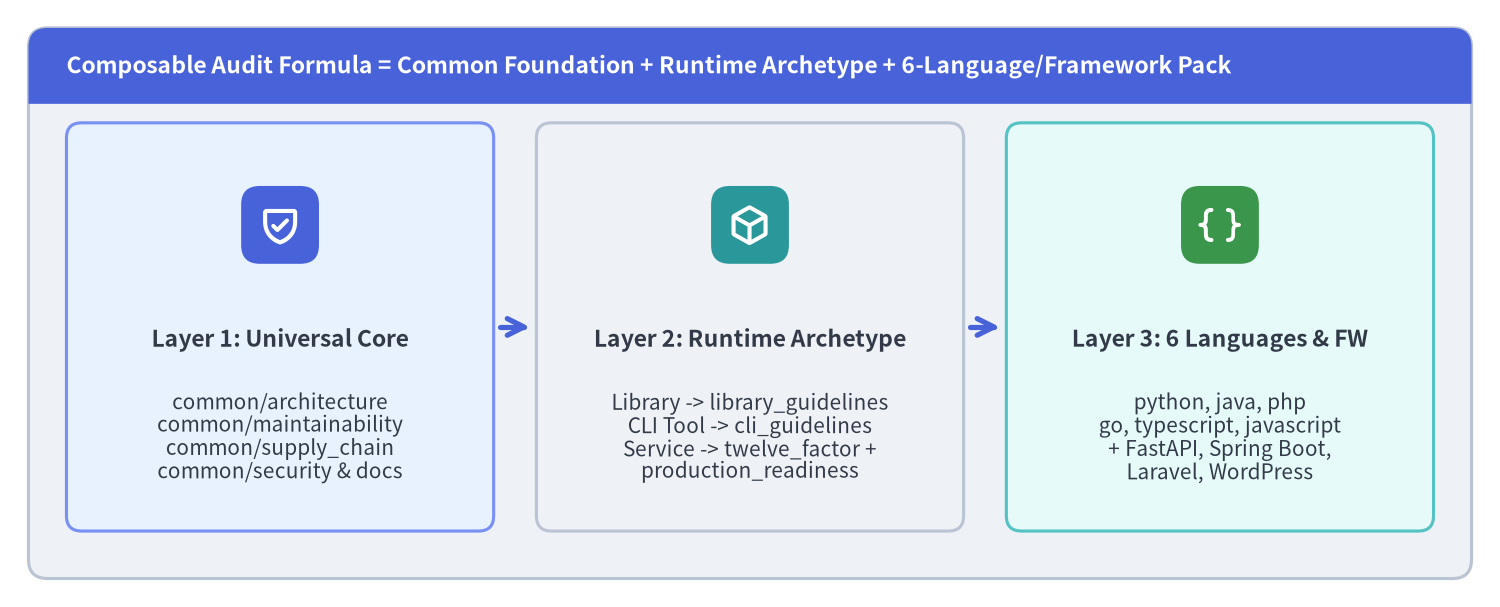
A recurring anti-pattern in static analysis toolchains is rewriting architectural, security, and operational rules separately for every programming language. In pni501, rules (src/pni/_rules/) and composite actions (src/pni/_actions/) are partitioned along two orthogonal dimensions:
- Universal Standards (
common/*): Govern invariants that hold true regardless of implementation language—such as layered dependency direction (common/architecture), SIG unit complexity limits (common/maintainability), OpenSSF lockfile and CI token hygiene (common/supply_chain), OWASP secret/injection defenses (common/security,common/security_vulnerability), 12-Factor statelessness (common/twelve_factor), Google SRE I/O timeouts (common/production_readiness),clig.devCLI ergonomics (common/cli_guidelines), public library API contracts (common/library_guidelines), and Diátaxis documentation (common/documentation). - Language Core Packs (
<lang>/*): Govern syntax-level idioms, compiler/type-checker strictness, package manager manifests, and unit test conventions across Python, Java, PHP, Go, TypeScript, and JavaScript—paired with 3 language-scoped composite actions (<lang>_ast_audit,<lang>_test_audit, andrepo_structure_audit). - Framework Overlay Packs (
<lang>/frameworks/*): Govern framework-specific lifecycle and DI patterns—such aspython/frameworks/fastapi,java/frameworks/spring_boot,php/frameworks/laravel, andphp/frameworks/wordpress.
Source Code
from drawlib.canvas import save, setup
from drawlib.icons import phosphor
from drawlib.smartarts import CardList, Panel
from drawlib.styles import Styles

setup(width=158, height=64, dpi=150)

panel = Panel(
    "Composable Audit Formula = Common Foundation + Runtime Archetype + 6-Language/Framework Pack",
    header_variant="filled",
    style=Styles.Neutral.patch(shape_r=2.0),
    header_style=Styles.PrimaryFlat,
    text_style=Styles.WhiteBold.patch(text_size=11.0),
)
panel.draw(xy=(3.0, 3.0), width=152.0, height=58.0)

layers = CardList(
    style=Styles.PrimaryNeutral.patch(shape_r=1.6),
    text_style=Styles.DarkBold.patch(text_size=11.0),
    description_style=Styles.Dark.patch(text_size=10.0),
    badge_shape="rounded_rect",
    badge_style=Styles.PrimaryFlat,
    badge_text_style=Styles.WhiteBold.patch(text_size=10.0),
    icon_style=Styles.WhiteBold,
    direction="horizontal",
    show_arrows=True,
    arrow_style=Styles.PrimaryBold,
    spacing=4.5,
)
layers.add(
    "Layer 1: Universal Core",
    "common/architecture\ncommon/maintainability\ncommon/supply_chain\ncommon/security & docs",
    icon=phosphor.shield_check,
)
layers.add(
    "Layer 2: Runtime Archetype",
    "Library -> library_guidelines\nCLI Tool -> cli_guidelines\nService -> twelve_factor +\nproduction_readiness",
    style=Styles.Neutral.patch(shape_r=1.6),
    badge_style=Styles.SecondaryFlat,
    icon=phosphor.cube,
)
layers.add(
    "Layer 3: 6 Languages & FW",
    "python, java, php\ngo, typescript, javascript\n+ FastAPI, Spring Boot,\nLaravel, WordPress",
    style=Styles.SecondaryNeutral.patch(shape_r=1.6),
    badge_style=Styles.SuccessFlat,
    icon=phosphor.brackets_curly,
)
layers.draw(xy=(7.0, 8.0), width=144.0, height=43.0)
save()
4. .pni/ Workspace Layout & Three-Tier Cascade Resolution
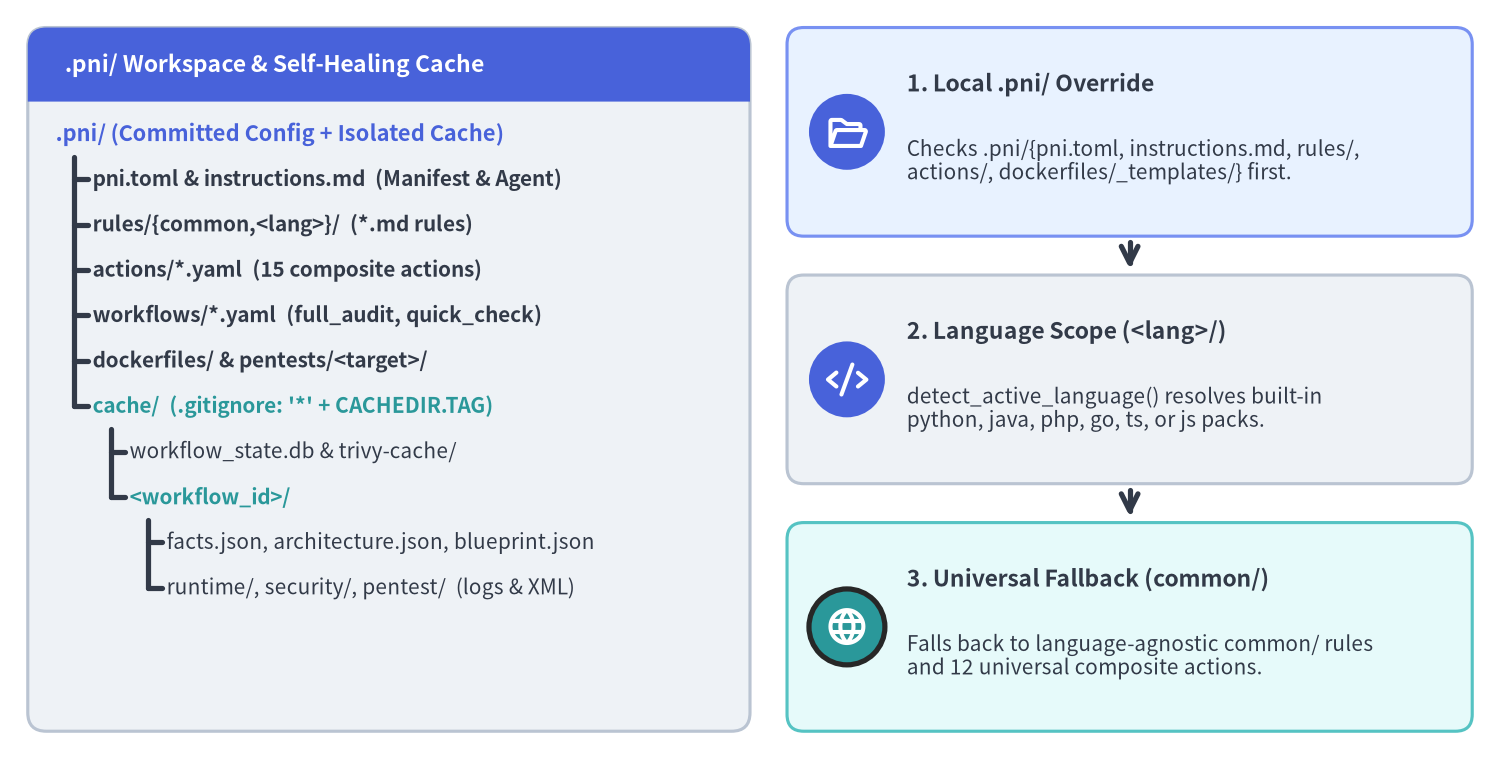
Running pni init [--lang/-l <python|java|php|go|typescript|javascript>] [--force/-f] invokes init_project() in src/pni/cli.py, seeding a transparent .pni/ configuration directory for the detected language while initializing the self-healing .pni/cache/ hierarchy.
Source Code
from drawlib.canvas import save, setup
from drawlib.icons import phosphor
from drawlib.smartarts import CardList, Panel, TreeNode
from drawlib.styles import Styles

setup(width=162, height=82, dpi=150)

left_panel = Panel(
    ".pni/ Workspace & Self-Healing Cache",
    header_variant="filled",
    style=Styles.Neutral.patch(shape_r=2.0),
    header_style=Styles.PrimaryFlat,
    text_style=Styles.WhiteBold.patch(text_size=11.0),
)
left_panel.draw(xy=(3.0, 3.0), width=78.0, height=76.0)

root = TreeNode(
    ".pni/ (Committed Config + Isolated Cache)",
    text_style=Styles.PrimaryBold.patch(text_size=10.5),
    line_style=Styles.DarkBold,
    line_horizontal_margin=2.0,
    line_horizontal_length=2.2,
    line_vertical_margin=4.9,
)
root.add("pni.toml & instructions.md  (Manifest & Agent)", text_style=Styles.DarkBold.patch(text_size=10.0))
root.add("rules/{common,<lang>}/  (*.md rules)", text_style=Styles.DarkBold.patch(text_size=10.0))
root.add("actions/*.yaml  (15 composite actions)", text_style=Styles.DarkBold.patch(text_size=10.0))
root.add("workflows/*.yaml  (full_audit, quick_check)", text_style=Styles.DarkBold.patch(text_size=10.0))
root.add("dockerfiles/ & pentests/<target>/", text_style=Styles.DarkBold.patch(text_size=10.0))
cache_dir = root.add(
    "cache/  (.gitignore: '*' + CACHEDIR.TAG)",
    text_style=Styles.SecondaryBold.patch(text_size=10.0),
)
cache_dir.add("workflow_state.db & trivy-cache/", text_style=Styles.Dark.patch(text_size=10.0))
wf_cache = cache_dir.add("<workflow_id>/", text_style=Styles.SecondaryBold.patch(text_size=10.0))
wf_cache.add("facts.json, architecture.json, blueprint.json", text_style=Styles.Dark.patch(text_size=10.0))
wf_cache.add("runtime/, security/, pentest/  (logs & XML)", text_style=Styles.Dark.patch(text_size=10.0))
root.draw(xy=(6.0, 67.5))

cascade_cards = CardList(
    style=Styles.PrimaryNeutral.patch(shape_r=1.8),
    text_style=Styles.DarkBold.patch(text_size=11.0),
    description_style=Styles.Dark.patch(text_size=10.0),
    badge_shape="circle",
    badge_style=Styles.PrimaryFlat,
    badge_text_style=Styles.WhiteBold.patch(text_size=10.5),
    icon_style=Styles.WhiteBold,
    direction="vertical",
    spacing=3.8,
    show_arrows=True,
    arrow_style=Styles.DarkBold,
)
cascade_cards.add(
    "1. Local .pni/ Override",
    "Checks .pni/{pni.toml, instructions.md, rules/,\nactions/, dockerfiles/_templates/} first.",
    icon=phosphor.folder_open,
)
cascade_cards.add(
    "2. Language Scope (<lang>/)",
    "detect_active_language() resolves built-in\npython, java, php, go, ts, or js packs.",
    style=Styles.Neutral.patch(shape_r=1.8),
    icon=phosphor.code,
)
cascade_cards.add(
    "3. Universal Fallback (common/)",
    "Falls back to language-agnostic common/ rules\nand 12 universal composite actions.",
    style=Styles.SecondaryNeutral.patch(shape_r=1.8),
    badge_style=Styles.SecondaryBold,
    icon=phosphor.globe,
)
cascade_cards.draw(xy=(85.0, 3.0), width=74.0, height=76.0)
save()
Self-Healing Cache & Target-Scoped Workspace Artifacts
Rather than modifying the host project's root .gitignore, src/pni/_cache.py (ensure_cache_dir() and ensure_cache_parent()) makes .pni/cache/ self-healing:
- Automatic Git & Backup Exclusion: Every write into
.pni/cache/automatically guarantees the existence of.pni/cache/.gitignore(*) and a standardCACHEDIR.TAGsignature (8a477f597d28d172789f06886806bc55), keeping SQLite databases, Trivy vulnerability DB caches (trivy-cache/), JUnit XML reports, and container logs out of Git status and backup archives even in uninitialized repositories. - Workflow-Isolated Ephemeral State (
.pni/cache/<workflow_id>/): Each workflow writes its aggregated snapshot tofacts.json, grounded 3-aspect architecture model toarchitecture.json, pre-sorted report specification toblueprint.json(ormigration_facts.jsonandmigration_blueprint.json), and raw stage artifacts intoruntime/,security/, andpentest/. - Path-Guarded Multi-Target Harnesses (
.pni/dockerfiles/&.pni/pentests/):normalize_target_subpath()rejects absolute paths and..traversal while mapping monorepo targets cleanly—for example,targets.root: examples/php/legacy_shop_messymaps to.pni/dockerfiles/examples/php/legacy_shop_messy/Dockerfileand.pni/pentests/examples/php/legacy_shop_messy/.
Three-Tier Cascade & 6-Language Resolution Rules
Teams can keep all seeded .pni/ files or delete unmodified files and retain only targeted overrides:
- Active Language Detection (
_rules/manager.py):detect_active_language(project_root)inspects manifests in strict priority order—Python (pyproject.toml,setup.py,requirements.txt), Java (pom.xml,build.gradle*,settings.gradle*), PHP (composer.json,wp-config*.php,artisan,phpunit.xml*), Go (go.mod,go.work), and Node/Frontend (tsconfig*.json,jsconfig.json,package.jsondistinguishingtypescriptvs.javascript)—before falling back to source-tree file heuristics (*.java,*.php,*.go,*.ts/*.tsx,*.js/*.jsx) and defaulting to"python". See Supported 6 Languages for language-specific analyzer details. - Engineering Rules (
local > <lang> > common):list_rules()merges(scope, name)candidates across built-insrc/pni/_rules/and local.pni/rules/for("common", active_lang)(or allSUPPORTED_LANGUAGESwith--all), preferring.pni/rules/<scope>/<name>.md(is_local=True).get_rule_content()resolves identifiers across hyphen/underscore normalization in four steps: exact<scope>/<name>-><active_lang>/<name>->common/<name>-> any matching rule name. - Composite Actions (
local > <lang> > common):load_composite_action()resolves.pni/actions/<id>.yaml(or scoped.pni/actions/<scope>/<id>.yaml) first, then built-in<active_lang>/<id>.yaml(enablinguses: repo_structure_auditto dispatch automatically topython/,java/,php/,go/,typescript/, orjavascript/), and finallycommon/<id>.yaml. See 15 Actions & 12 Primitives for the full catalog. - Container Harnesses, Manifests & Instructions:
resolve_template_dockerfile()prioritizes.pni/dockerfiles/_templates/<lang>/<tool>.dockerfileover built-insrc/pni/_dockerfiles/<lang>/<tool>.dockerfile(with per-language fallback topip,maven,composer,go, ornode), whileload_pni_config()loads.pni/pni.tomlandget_instructions_info()prioritizes.pni/instructions.mdoversrc/pni/_instructions/agent.md.
# Inspect active rules, composite actions, and cascade override status
pni rules list --all
pni rules show common/architecture
pni workflows show full_audit